ServiceNow Operational Visibility
Your System Says Everything Is Under Control. So Why Does Your Team Keep Checking Somewhere Else?
The dashboard is green. The workflow says “complete.” The records are populated. The reports are available. From the outside, everything looks under control.
Then an important decision has to be made.
Someone opens a spreadsheet. Someone checks an old email. Someone asks another team to confirm ownership. Someone verifies whether the information in the platform is still current. Someone delays action until the system has been checked against something else.
The platform says the organisation has control. The team’s behaviour suggests something different.
That is the hidden trust gap.
It is not a dramatic system failure. The platform does not go down. The workflow does not stop. There may be no alert, no incident and no obvious red flag.
Work continues. People simply stop depending on the system completely.
When the System of Record Stops Being the Source of Truth
People know which field needs to be checked, which report needs to be corrected, which owner to call, which spreadsheet contains the latest version, and when email is faster than the workflow.
The system remains live. But the operating reality begins to move somewhere else.
That is why the gap can remain hidden for months - sometimes years.
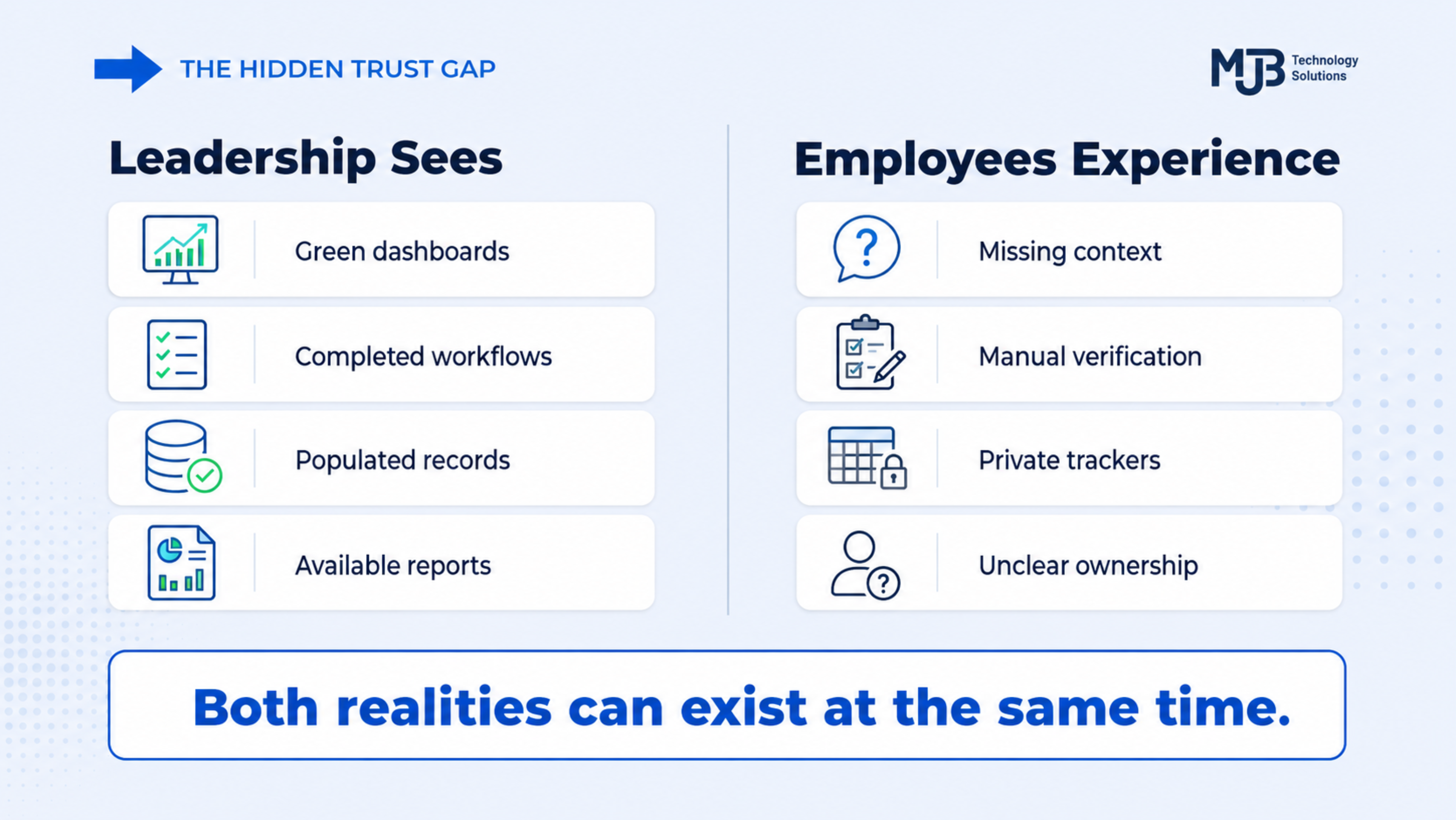
Leadership sees completed workflows. Employees experience the hidden work needed to complete them.
Leadership sees populated records. Employees know which records still need to be verified.
Leadership sees available reports. Employees may be correcting those reports before anyone acts on them.
Leadership sees control. Employees experience uncertainty.
Both realities can exist at the same time.
That is where a more important question begins.
A system can be technically healthy and still be operationally untrusted. A field can be populated and still be questioned. A workflow can show “complete” while critical conversations happen outside it.
A dashboard can be green while the people closest to the work continue validating the truth manually.
The platform may still be the system of record. But is it still the source of truth?
For organisations looking more broadly at this issue, MJB’s guide to ServiceNow operational visibility explores why active workflows and visible dashboards can still leave leaders without a complete operating picture.
The Work Your Dashboard Does Not See
When manual checking becomes normal, it rarely feels like failure. It feels like experience. It feels like caution. It feels like “just double-checking.”
Each workaround can look reasonable on its own. The risk appears when the workaround stops being the exception.
A temporary tracker becomes permanent. A manual ownership check becomes part of every high-risk change. An email approval becomes the real approval path. A particular employee becomes the person everyone calls because they know what the system does not.
At that point, the documented process and the working process are no longer the same thing.
When Workarounds Become the Real Process
The workflow may exist inside the platform. The operating truth may exist across several places: a spreadsheet, an inbox, a chat thread, a local tracker, a call or a person’s memory.
The organisation may believe it has one source of truth. In practice, employees may be reconstructing that truth every time the decision carries risk.
That is the workaround reality.
Once that becomes normal, the organisation starts measuring the result without seeing the hidden effort required to create it.
A ticket is resolved, but the system does not show how many people were contacted to identify the right owner. A change is approved, but the platform may not show the manual dependency checks that happened before approval. A report reaches leadership, but the dashboard may not show that someone corrected the data before sending it.
The outcome is visible. The hidden work is not.
This is closely related to the broader question of whether a ServiceNow dashboard shows activity or actual business risk . Reporting can be accurate and still fail to reveal the effort, uncertainty and operational exposure surrounding the recorded result.
More automation does not automatically create trust. More records do not automatically create confidence. More dashboards do not automatically create visibility.
The real question is not whether the organisation has enough technology. It is whether the technology reflects how work is actually being done.
The Trust Gap Becomes Visible When Risk Is High
Consider the last important decision your team made. Did people act on the information immediately, or did someone ask:
- Is this still correct?
- Who owns this now?
- Can someone confirm the impact?
- Are these dependencies current?
- Do we have another report?
- Can we check the latest spreadsheet?
Those questions are useful signals. Not because every verification step is wrong - reasonable validation will always exist - but because the pattern reveals where trust actually sits.
If the platform is trusted, verification should be the exception. If verification becomes the default, something has changed.
Trust is leaving the platform.
During routine work, experienced employees compensate. Workarounds function. Local trackers remain current. The right people know whom to call.
Then something removes the safety net: a critical incident, a high-risk change, a security event, an audit, a leadership review or a customer-impacting disruption.
Suddenly the organisation needs answers quickly. What is affected? Who owns it? What depends on it? Which information is current? What is the business impact? Which version should be trusted?
That is when the hidden trust gap stops being invisible. The process may still exist and the platform may still be available, but the organisation discovers how much control depended on people quietly rebuilding the truth outside the system.
Availability is not trust. Completion is not control.
A technically operational ServiceNow environment does not automatically mean the organisation has operational confidence.
The important question is not whether the system contains information. It is whether the organisation is willing to act on that information.
For a broader operating-model view, the ServiceNow Operational Optimization hub connects workflow, governance, CMDB reliability, automation and visibility gaps that can quietly reduce enterprise value after go-live.
Would Your Teams Act Without Verifying Somewhere Else First?
Now consider the behaviour around your own platform.
How often do employees leave it to verify information? How often are reports corrected before they are trusted? How many important decisions depend on personal knowledge? How many “temporary” trackers have quietly become permanent?
How often does leadership see the completed result without seeing the manual work required to create confidence in it?
Those questions may reveal more about operational maturity than another green health score.
If that answer is not obvious, the dashboard may be telling the truth - just not the whole truth.
Frequently Asked Questions
These questions can help ServiceNow leaders and operational teams identify whether a healthy-looking platform is also a trusted operational source of information.
What is a ServiceNow operational trust gap?
A ServiceNow operational trust gap appears when the platform contains records, workflows and reports, but employees still verify important information through spreadsheets, email, personal knowledge or other sources before acting. The platform may remain technically operational while confidence in its information begins to move elsewhere.
Why do teams verify ServiceNow data manually even when dashboards are healthy?
A healthy dashboard can show that records are populated, workflows are completed and reports are available without showing whether teams trust that information enough to act on it. Manual verification may continue when ownership, context, relationships or operational information are considered incomplete, outdated or uncertain.
What is the difference between a system of record and a source of truth?
A system of record is the official location where information is stored and managed. A source of truth is the information people actually trust when making decisions. A platform can remain the formal system of record while employees rely on spreadsheets, email threads or experienced colleagues as the practical source of truth.
How can manual workarounds affect ServiceNow governance?
When manual workarounds become part of normal operations, important decisions and validations can move outside formal workflows. This can reduce visibility into ownership, approvals, data confidence and operational risk because the platform records the final outcome without necessarily capturing the hidden work used to produce it.
How can organisations identify hidden operational gaps in ServiceNow?
Organisations can examine how employees behave around the platform: how often information is verified elsewhere, whether reports are corrected manually, whether temporary trackers have become permanent, whether important decisions depend on personal knowledge, and whether teams would act on ServiceNow information without first checking another source. A structured operational assessment can help expose these gaps.
See What Your Dashboard May Be Missing
The MJB ServiceNow Operational Assessment helps organisations examine hidden gaps across operational trust, ownership, workflow usage, governance, visibility and measurable platform value.
Facing similar ServiceNow challenges?
Get a free ServiceNow assessment and understand where your platform may be losing value.
No spam. No sales pressure. Only actionable insights.